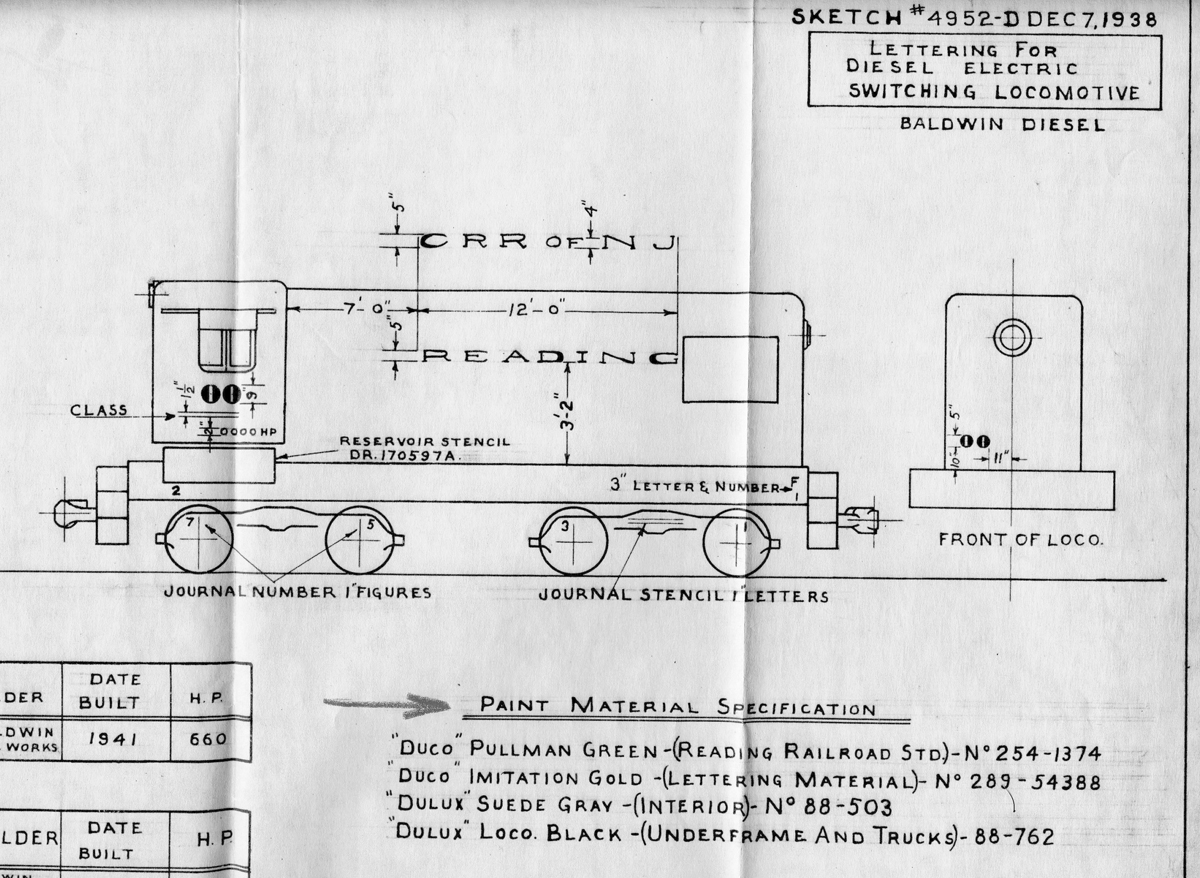
My brother Bobb sent this partial scan to tease me a little today. It’s from a lettering diagram for Reading and CNJ switchers. The drawing was first released on 12/7/38 and is updated through 1944.
It does identify “Duco Pullman Green -(Reading Railroad Standard)- No. 254-1374″
Now to research the modern version of that paint. Still might not be what’s on the AS-16′s, but it’s another step closer.
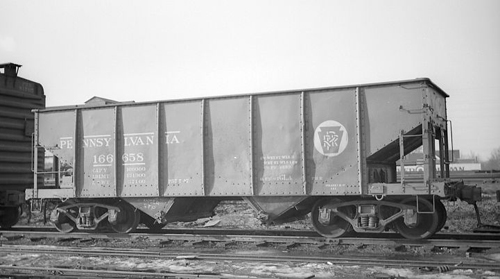
The Pennsylvania Railroad class GLa is a 50 ton twin open hopper car. Construction began in 1904 and continued through 1991. A total of 30,256 were built for the PRR or acquired from various coal companies that built the same design.
The April 1956 OER lists 21,840 GLa’s on the roster. Compare this to Reading’s 13015 total hopper cars, or Western Maryland’s 8006 total hopper cars and you begin to see the size of the PRR fleet of GLa’s.
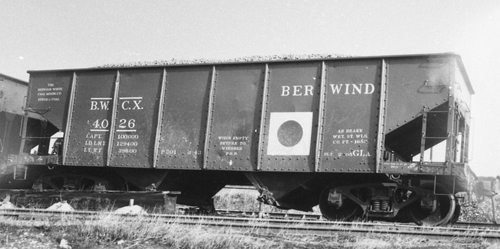
The GLa was originally built with K brakes and later converted to AB. Very few GLa were updated with power brake wheels most cars retained their verticle brake staff. One exception would be the second hand cars acquired from Berwind-White, which had modern power hand brake hardware.
It’s interesting to note that the overall dimensions of the GLa are close to the USRA Standard 50-Ton Twin Hopper which was designed almost 15 years later. Inside Length is one inch shorter at 30′ 5″. Inside width 9′ 5 1/2″ is a half an inch wider then the USRA Twin. The GLa is 8″ shorter to the top of side cord at 10′ 0″ but the side height is only 5″ shorter as the bottom of the car side sits three inches lower than the USRA Twin. The GLa has a capacity only 197 cu. ft. less that the USRA Twin. These similiarities will work in our favor when it comes time to build a fleet of these cars.
BCWX 4026 GLa – George Losse collection
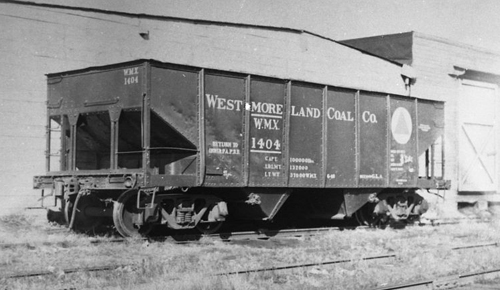
WMX 1404 GLa – George Losse collection
References:
Keystone Article
PRR Steel Open Hopper Cars – John Teichmoeller
January 1952 Official Railway Equipment Register
September 1953 Official Railway Equipment Register
April 1956 Official Railway Equipment Register
O Scale Models: Chooch #674 Pullman Flat Car – Ultra Scale line of resin cars.
Wiseman Model Services appears to be producing a similar kit.
The History:
The American Association of Railroads (AAR) Committee on Car Construction established a standard for 53’ 6” flat cars based upon a 1941 Pullman-Standard Company design. The earliest users of this design were the Chicago Great Western, Monon, Soo and UP. The design established a new standard for deck height of 42” which was lower than previous car designs. This feature would permit taller loads without exceeding established clearance limits. It also had a much wider deck extending beyond the fishbelly sides. Twenty railroads built 2532 cars to this basic design.
The car spanned a long period of operation ranging from 1941 to the 1980’s. Some roads converted these cars into piggyback carriers or fitted them with bulkheads for building materials. Many of the cars ended up in maintenance of way service after a long revenue life.
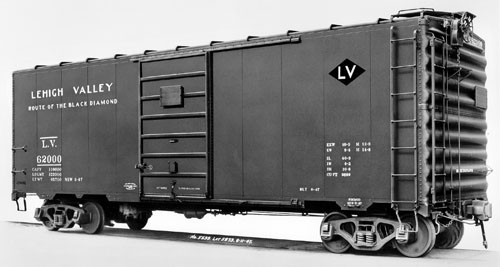
Pullman Standard introduced its PS-1 boxcar in the late 1947. There are a number of articles about the PS-1’s in the Hobby press. I’m not going to restate everything that has been written about this design of cars.
Ed Hawkins and Ted Culotta compiled a list of all the PS-1’s built. The complete list of Pullman PS-1 boxcars can be found on the Steam Era Freight Car Website.
Below is a modified version of their information sorted by the build-date of the cars built before my modeling period, the Summer of 1952.
Pullman Standard built a total of 77,570 cars, but by 7/52 only 46,847 had been built. These are the only cars that existed and could have been seen by my modeling period, so this is a list of the only cars that can be on the layout. Now I don’t plan to build every one of these, but the four or five I do plan to build are on this list.
This will also give me other other information then just what details are on the car and which road. By knowing if the car is less than one year old it means it should look close to brand new. Or if it’s one of the LV car built in 1947 it should look like it has been in service for five years.
Lionel and Weaver both make version of this car in O scale. The Lionel car is available with a 6ft, 7ft and 8ft door. The Weaver is only available with an 8ft door. Protocraft makes a number of decals for these cars, I’ve linked the reporting mark (first column) to the decal pages with photos of the cars.
Bert Pennypacker speaks about the Reading Mallets 2-8-8-2 in his Mainline Modeler article on the K1’s. They were built by Baldwin beginning with six locomotives received in 1917. Two additional orders brought the fleet up to 31 locomotives by 1919 and were classes N1-sa/b/c. They were numbered 1800-1830, with 55.5 inch drivers and 98,400 lbs of tractive force.
The mallets were distributed in different parts of the system, 11 were running between Hagerstown-Rutherford-Allentown, two were assigned to Reading as Temple Hill pushers, and the rest were were distributed through the coal regions, West Cressona, St.Clair, Tamaqua, Gordon and Shamokin. The locomotives assigned to pusher duties were given small capacity tenders, 8,000 gallons and12.8 tons of coal. While the road mallets were given larger tenders with 11,000 gallon and 18 ton capacity. Wages were cheap and pusher runs were short, no need for big tenders.
It was said of the Mallets that they could pull anything slowly. The Reading most not have been totally happy with the speed of the N1’s in road service. Beginning in 1927, locomotives #1800-1810 (11) were rebuilt into the K1 2-10-2 locomotives. They were only ten years old at the start of the project. Their boilers were reused and most of their parts in the rebuilding project.
Reading N1 drawing from Locomotive Cyclopedia
Then in 1930 the railroad began converting the mallets from compound to single expansion cylinders. They were re-classed as N1-sd. The big delivery pipes on the side of the smoke box are an indication of the converted locomotives. All the N1’s were converted by 1945. They also had their trailing trucks removed between 1940-1944.
Reading N1-sd moving a train in coal country.
In the late 1940’s ten N1-sd’s received new smoke boxes and cross-compound air pumps relocated onto the smoke box front. The locomotive that had the forward mounted air pumps were numbered; 1811, 1812, 1817, 1820, 1822, 1823, 1826, 1828, 1829 and 1830.
Reading N1-sd sporting air pumps on the smoke box
Reading 1814 N1-sd on the move.
Nice to have both sides of Reading1814 here at Tamaqua, PA.
References: Mainline Modeler, May/June 1981 – “Reading 2-10-2 It should have been a Texas” by Bert Pennypacker Reading Steam Pictorial
Photograph’s from George Losse Collection scanned from prints and/or original negatives.
The Reading received their first 1000 HP. switcher form EMD in the form of an NW2 #90, on September 5, 1940. This missed out being the first 1000 HP. switcher on the Reading by three weeks to #80 a Baldwind VO-1000.
NW2’s numbered #91-92 arrived in early October of 1941. After World War 2 was over the Reading added five more NW2’s to the roster numbers #100-104.The second series of NW2’s differed slightly from the first three by having louvers in the engine compartment doors.
The First three were originally assigned to the Shamokin Division. Eventually, they migrated to other parts of the railroad.
All the locomotives were delievered in the Pullman Green scheme. None were repainted into the green and Yellow scheme. One locomotive #104 was repainted into the last solid green scheme. Not all switcher received the rain gutters, #91 was photographed in 1963 without gutters.
References:
Diesel Era – 1996 March/April – Reading’s Repowered Switchers.
Diesel Era – 1998 March/April – Reading’s First-Generation Diesels by by Paul K. Withers
Reading Diesels Volume 1 The First Generation – by Dale Woodland Photograph’s from George Losse Collection scaned from negatives.
The Reading class OE-10 applies to both VO-1000 and early DS4-4-1000 end cab switchers. While the majority of the switchers on the Reading where concintrated in the Philadelphia area, the OE-10’s were seen in all parts of the railroad including the Shamokin Division.
The first pair of VO-1000’s #80-81 arrived in August of 1940 and had ovel grills like they early VO-660’s.
Reading OE-10 #80 at Shamokin, PA
The next VO-1000’s to arrive looked very muck alike. They had curved walkway boards, point radaitor grills in the front and single exhaust stacks near the cab.
Reading OE-10 #78
In September of 1944 the Reading received #55-59, their last of their VO-1000’s from Baldwin. They differed from the earlier VO’s by having square cornered walkways.
Reading OE-10 #57 is an example of the later car body style for the VO-1000
Reading OE-10 #56
The next group to be delievered #34-36 were amoung the first group of DS4-4-1000’s to be built. According to the Baldwin book they were built with parts left over from the VO production. The #35 has a VO radiator.
Reading OE-10 DS4-4-1000 with a VO front end
The rest of the DS4-4-1000’s had flat radiators. The DS4-4-1000’s were delievered with four exhaust stacks.
During the war Baldwin had found that the exhaust back-pressure could be reduced with the four stack exhaust and it reduced the heat the generator was subjected to increasing its efficiency. Restrictions from the War Production Board prohibited making the change during the war to the VO-1000’s. After the war Baldwin recommended that the change be made to the VO-1000’s Reading did that to some of their locomotives during later overhauls.
References:
Diesel Era – 1996 March/April – Reading’s Repowered Switchers.
Diesel Era – 1998 March/April – Reading’s First-Generation Diesels by by Paul K. Withers
Reading Diesels Volume 1 The First Generation – by Dale Woodland Photograph’s from George Losse Collection scaned from negatives.
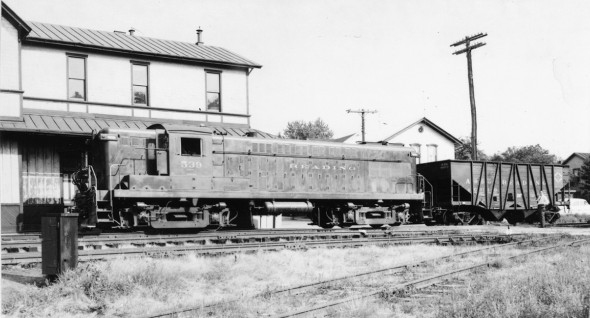
The Reading Company had been a long time buyer from Baldwin locomotive Works. They had bought steam locomotive from them and had been very happy with the diesel switchers made by Baldwin. When the railroad turn to the road switcher models they again turned to Baldwin and bought their AS-16 model.
There are good sources of information on these units in print. Here is a short list:
Diesels of the Reading Company Volume 1, Paul K. Withers
Reading Diesels Volume 1 The First Generation, Dale Woodland
While each group of AS-16’s were different they did have a few things in common. They all had walkways over the top of the vent in the roofs. Most had louvers on the engineer’s side of the long hood under the air intakes. They all had railroad applied rain gutters applied to the cab roofs.
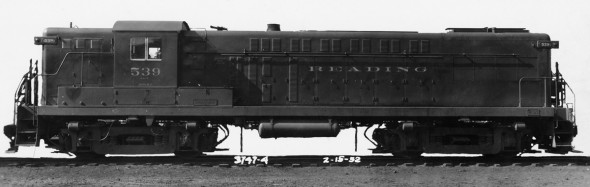
All the AS-16’s were delivered in the Pullman Green paint scheme, and they wore it until they were retired. As delivered they had green handrails and low numbers on the ends of the locomotives. During sometime around 1953 the handrails were painted the safety yellow. Sometime near 1956 the end numbers started to move up on the end. I would imagine so that the tower operators could see the numbers.
The first group #530-537 arrived on the property from 7/51-9/51. They were straight freight locomotives without dynamic brakes. They had 900 gallon fuel tanks above the frame directly behind the cabs, leaving the space between the trucks under the locomotive open. Their bell’s were mounted at the top of the long hoods. The long hoods were forward.
The next four locomotives to arrive were 560-563 were dual controlled, steam generator equipped passenger locomotives. They were based out of Green Street engine house. Their 1000 gallon fuel tank was under the frame between the trucks. The 900 gallon tank behind the cab was used for water for the steam generator. The bell was still mounted on the end of the locomotive.
The next group of freight units #538-550 arrived 10/51-11/51. Externally they differed from the first group of freight units only in the moving of the bell from the end to under the frame on the fireman’s side of the front of the locomotive. Not visible to the modeler they were heavier than the first group by 1100 lbs.
The next group of AS-16’s #576-589 arrived on the property between 6/52-7/52. They were equipped with dynamic brakes in the short hood, the bell mounted under the frame, had a 1000 gallon fuel tank under the frame between the trucks and did not have a tank of the short hood end of the locomotive. In addition they were 1300 lbs. heavier than the last group of freight locomotives.
The grill work in the short hood for the dynamic brake required the number boards be moved up the car side to the top of the short hood.
The last group of Baldwins #551-554 arrived 10/53. The order started out a 10 units but the railroad cut the order to just four units. The six locomotives left over at Baldwin were later sold to the PRSL without the Dynamic brake equipment. This was also the first use of Baldwin’s new carbody design which had enough room to move the dynamic brake equipment into the long hood. This order went back to the use of the 900 gallon fuel tank behind the cab. leaving the space under the long hood between the trucks open.
One of the problems the railroad had with the Baldwins was that they could not MU with other locomotives. Worse than that, they could not even MU with each different order. The 1951 locomotives could not MU with the 1952 units until the railroad made modifications to the load regulators, costing the railroad $16,820 per unit for the modifications. This could also account for why early photos of the Baldwins show them MU’ing with other units from the same orders. The 1953 locomotives never were able to MU with the rest of the Baldwin fleet. They had electric throttles which aloud them to MU with other manufactures locomotives but not the other Baldwins.
Most of the photos that have been published have been of the units later in life. This is understandable as they replaced steam locomotives as they arrived and most railfans tried to capture what was going away instead of what was replacing it. Why not, the new units would be around for another 15 years? What few photos are around of the units in their first years show that changes came to them early. I’ve already pointed out the numbers on the ends move higher. The hand rails get painted with safety colors and also they added louvers under the long hood’s air intake on the engineer’s side of the locomotive. This appears to have happened in late 1952 or early 1953, after my modeling period of the Summer of 1952.
Below is a chart of the Baldwin AS-16 roster on the Reading. Some of the data is pulled from the Diesel Era article on the Reading AS-16’s and some from photos. Assignment refers to engine house assignments painted on the locomotive as seen is photos of the units.
No.
Built
DB
Bell
Fuel Tank
Assignment
530
7-51
–
Top
Walkway
StC
531
8-51
–
Top
Walkway
SH
532
8-51
–
Top
Walkway
G
533
8-51
–
Top
Walkway
CATA
534
9-51
–
Top
Walkway
G
535
9-51
–
Top
Walkway
536
9-51
–
Top
Walkway
SH
537
9-51
–
Top
Walkway
G
538
10-51
–
UF
Walkway
G
539
10-51
–
UF
Walkway
540
11-51
–
UF
Walkway
R
541
11-51
–
UF
Walkway
542
11-51
–
UF
Walkway
StC
543
11-51
–
UF
Walkway
G
544
11-51
–
UF
Walkway
SH
545
11-51
–
UF
Walkway
546
11-51
–
UF
Walkway
StC
547
11-51
–
UF
Walkway
548
11-51
–
UF
Walkway
549
11-51
–
UF
Walkway
550
11-51
–
UF
Walkway
StC
551
10-53
LH
UF
Walkway
552
10-53
LH
UF
Walkway
553
10-53
LH
UF
Walkway
554
10-53
LH
UF
Walkway
560
9-51
–
Top
UF
GS
561
9-51
–
Top
UF
GS
562
9-51
–
Top
UF
GS
563
9-51
–
Top
UF
GS
576
6-52
SH
UF
UF
577
6-52
SH
UF
UF
578
6-52
SH
UF
UF
579
6-52
SH
UF
UF
StC
580
6-52
SH
UF
UF
581
6-52
SH
UF
UF
StC
582
7-52
SH
UF
UF
583
7-52
SH
UF
UF
StC
584
7-52
SH
UF
UF
585
7-52
SH
UF
UF
StC
586
7-52
SH
UF
UF
StC
587
7-52
SH
UF
UF
StC
588
7-52
SH
UF
UF
589
7-52
SH
UF
UF
StC
References:
Diesels of the Reading Company Volume 1, Paul K. Withers
Diesel Era – 1991 September/October – Reading Baldwin AS-16 Road Switchers by Gerard E. Bernet.
Diesel Era – 1998 March/April – Reading’s First-Generation Diesels by by Paul K. Withers
Reading Diesels Volume 1 The First Generation – by Dale Woodland
Photograph’s from George Losse Collection either scanned from negatives or prints.
The story of the Reading K1 2-10-2 is told very well in a 16 page article in the May/June 1981 issue of Mainline Modeler by Bert Pennypacker “Reading 2-10-2 It should have been a Texas” I do not plan to go into all the details the article did, instead I’ll go over the highlights. There is an HO scale drawing of the K1sd in the center spread of the magazine.
The Reading 3000-series K1 started as a rebuilding program in 1927 with parts supplied by Baldwin. The first 11 locomotives were rebuilt in the Reading Shops from N1’s 2-8-8-2 which were built between 1917-1919. An additional ten locomotives (3011-3020) were built by Baldwin. The 3000-3009 were classed K1-sa, 3010 was classed K1-sc, and the 3011-3020 were classed K1-sb.
The 3010 was classed K1-sc because it was built with Caprotti valve gear. This proved to be troublesome to operate and costly to maintain. In 1942 it was replaced with the same Walscheart valve gear the others locomotives had and the 3010 was re-classed as K1-sa.
In 1945 while the Reading shops were busy building the T1 4-8-4’s the K1received some modernization changes including dynamically cross-balanced Baldwin disc main driving wheels, tapered main rods and high speed drifting valves. These changes where made to increase the K1’s potential speed from 50 to 60 m.p.h. making them similar to the new T-1’s. The locomotives were re-classed from K1-sa/b to K1-sd/e.
By 1948, the diesels arriving on the railroad started to bump the K1’s from their normal routes. They started to be reassigned into the coal regions and on the Shamokin Division.
The class survived intact until the first end of steam on the Reading in the beginning of 1954. The rebuilt K1’s were first to be retired in May of 1954. Followed by the Baldwin built locomotives in March of 1955. There were No survivors from the scrappers torch.