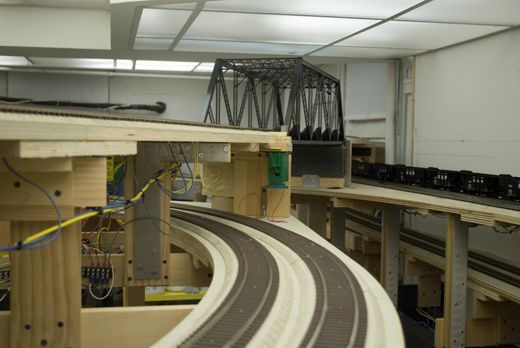
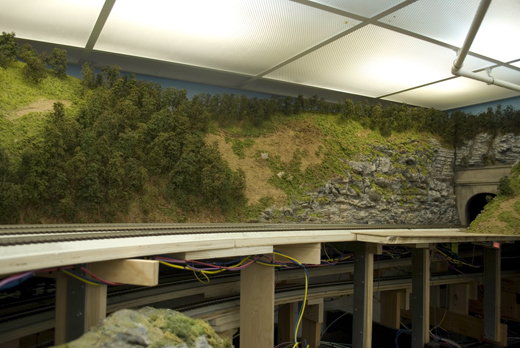
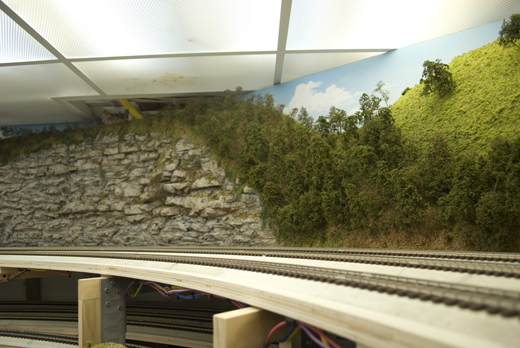
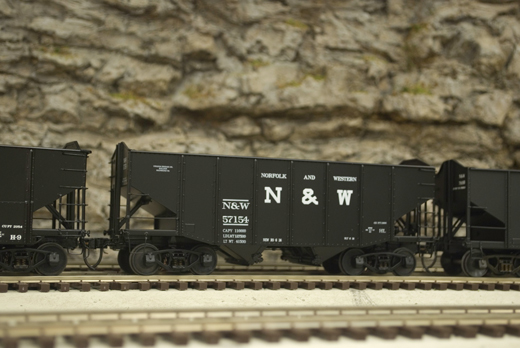
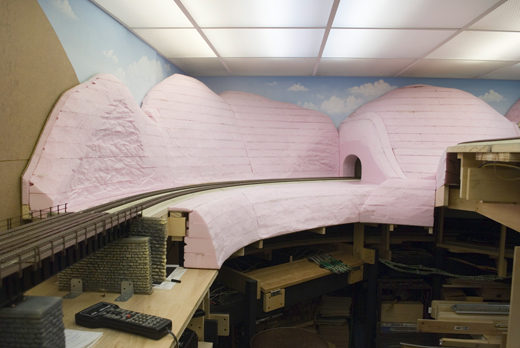
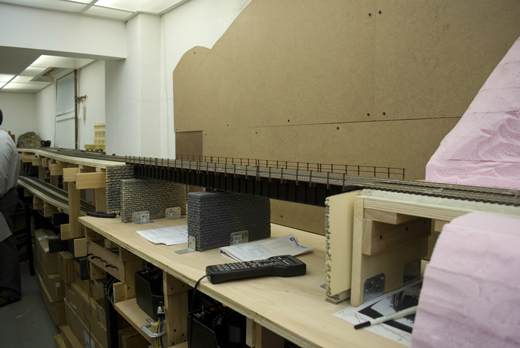
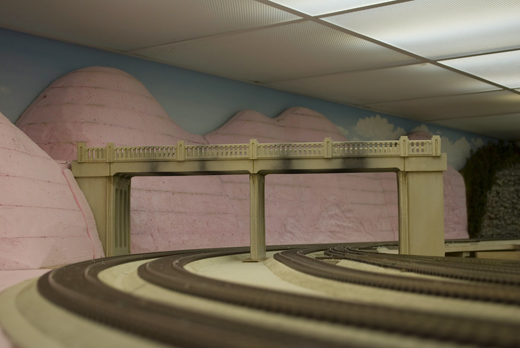
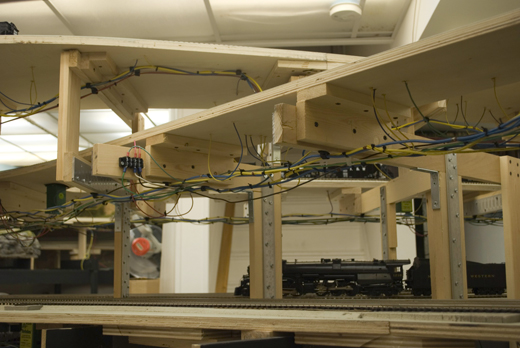
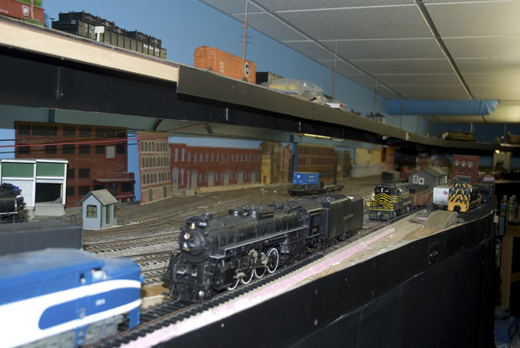
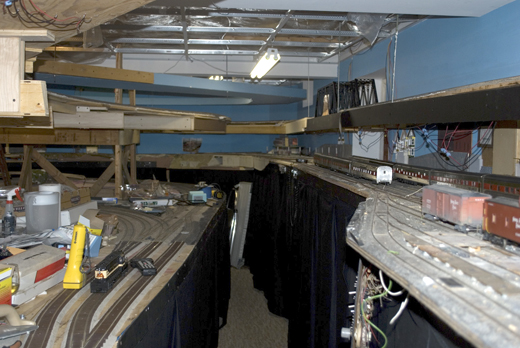
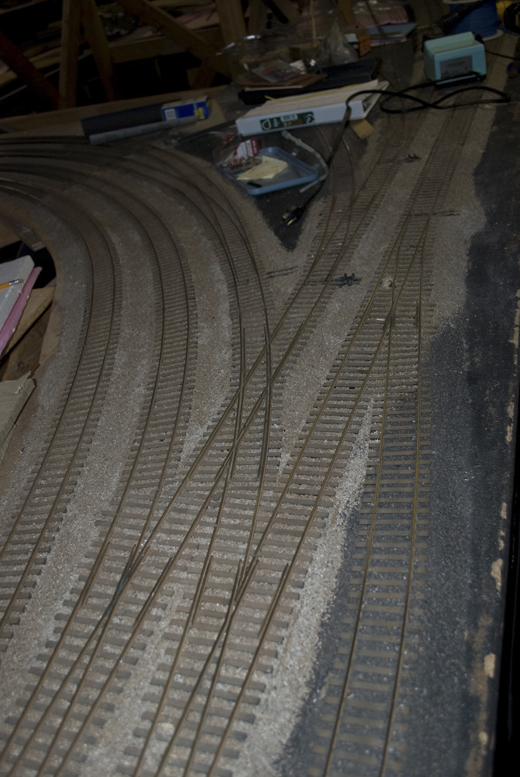
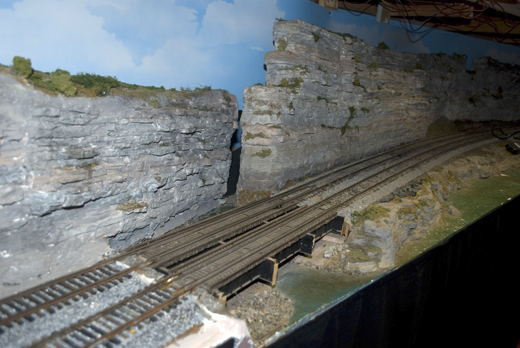
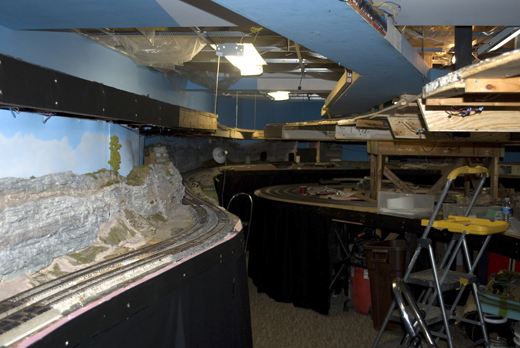
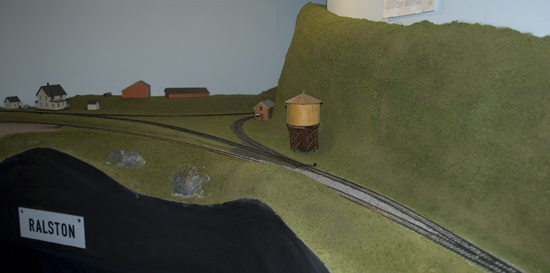
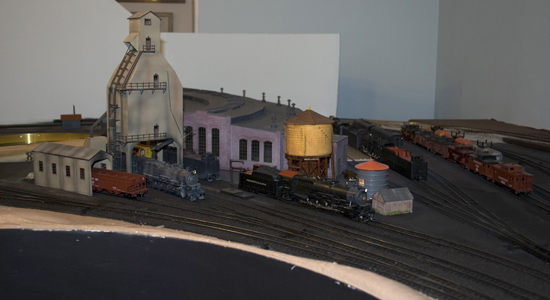
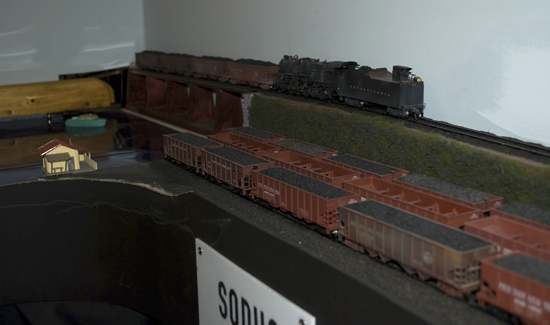
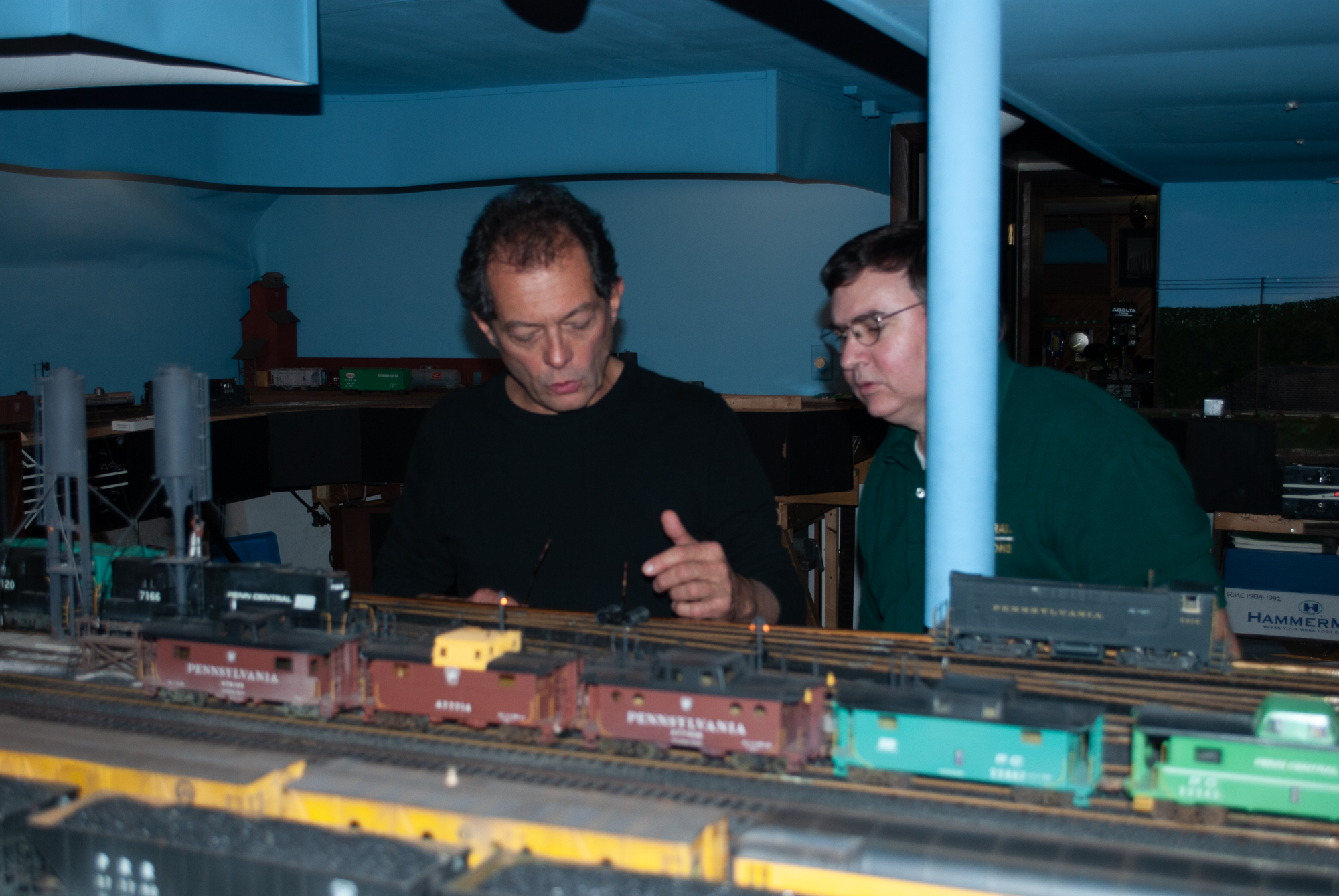
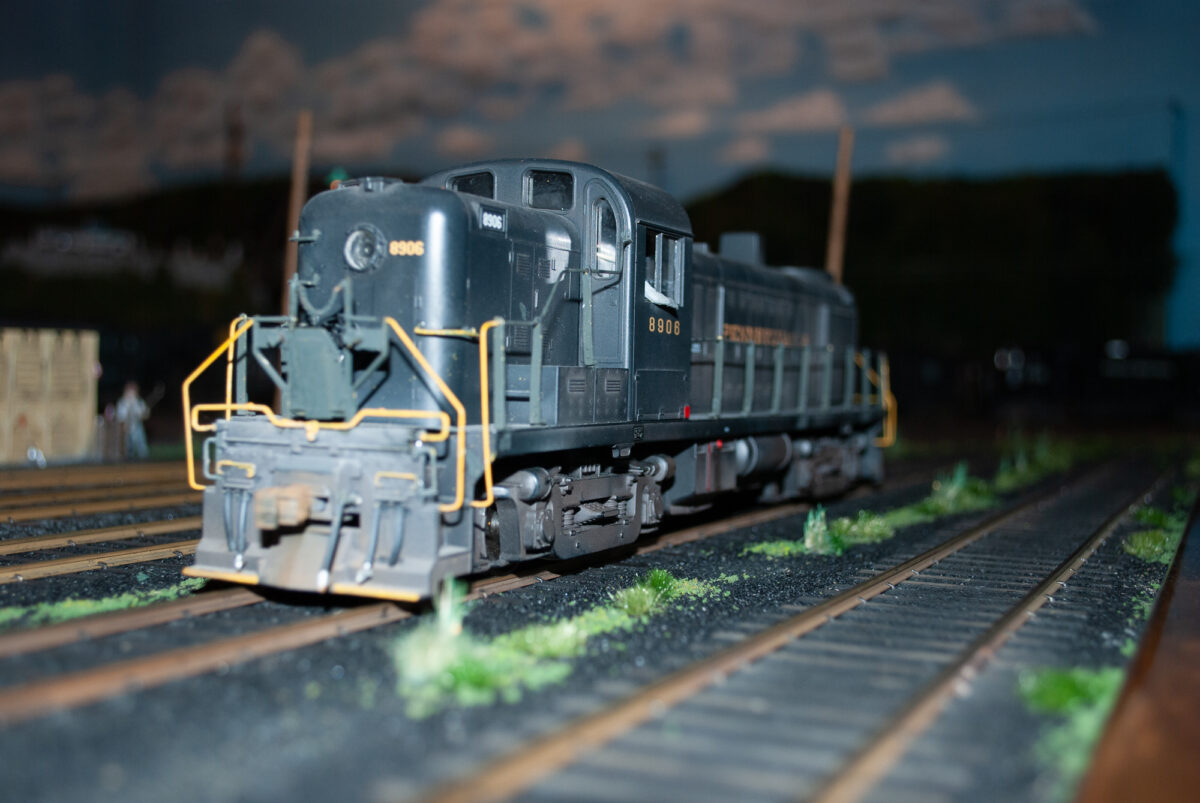
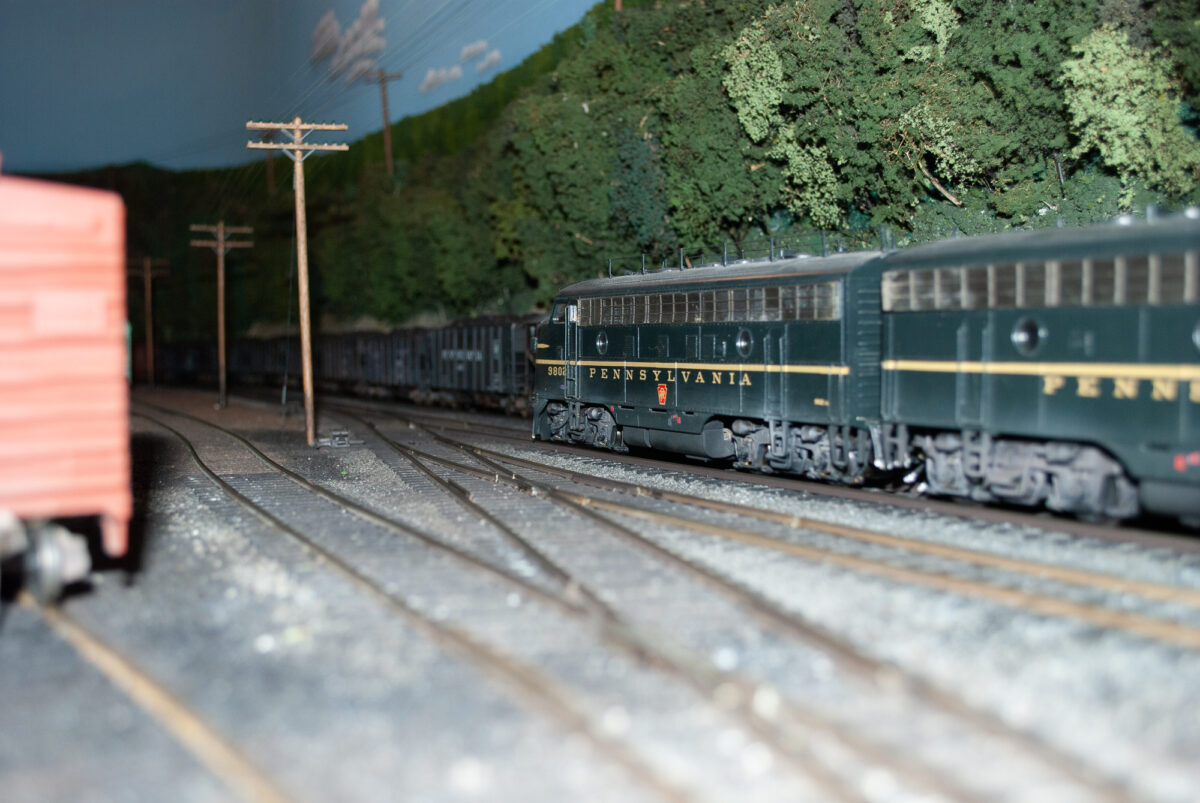
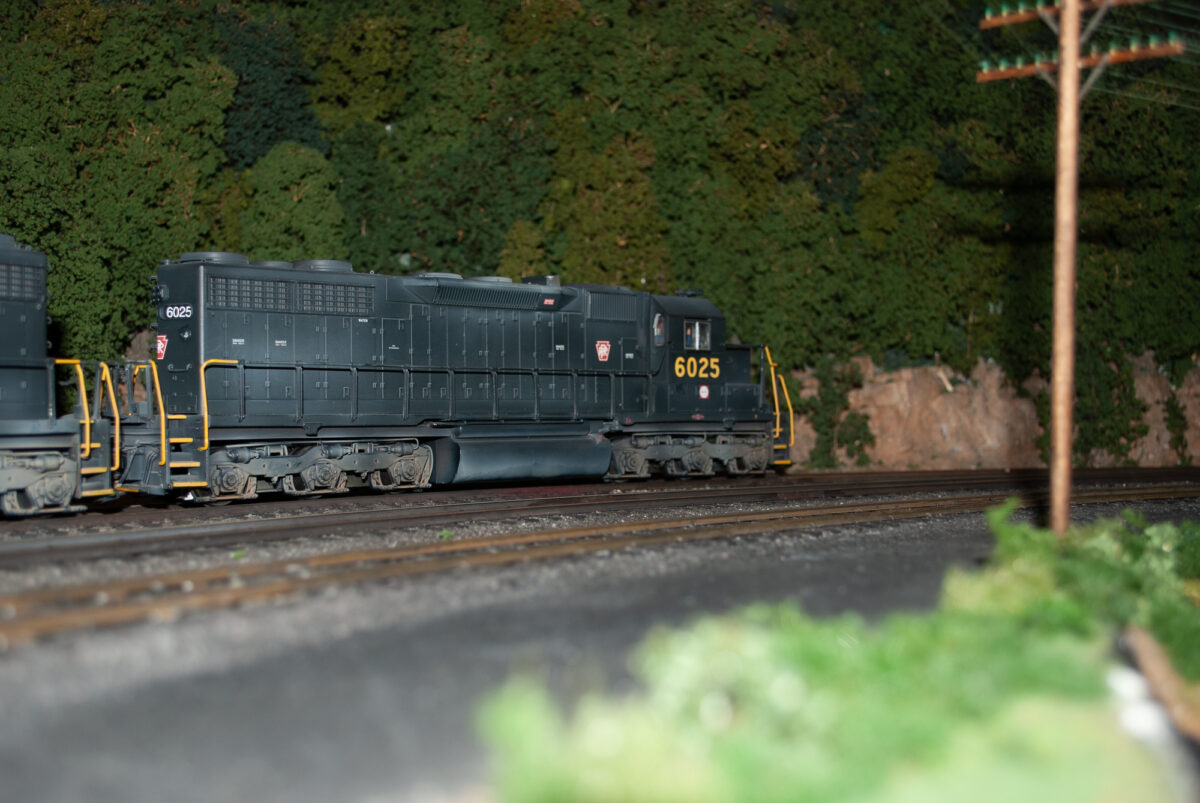
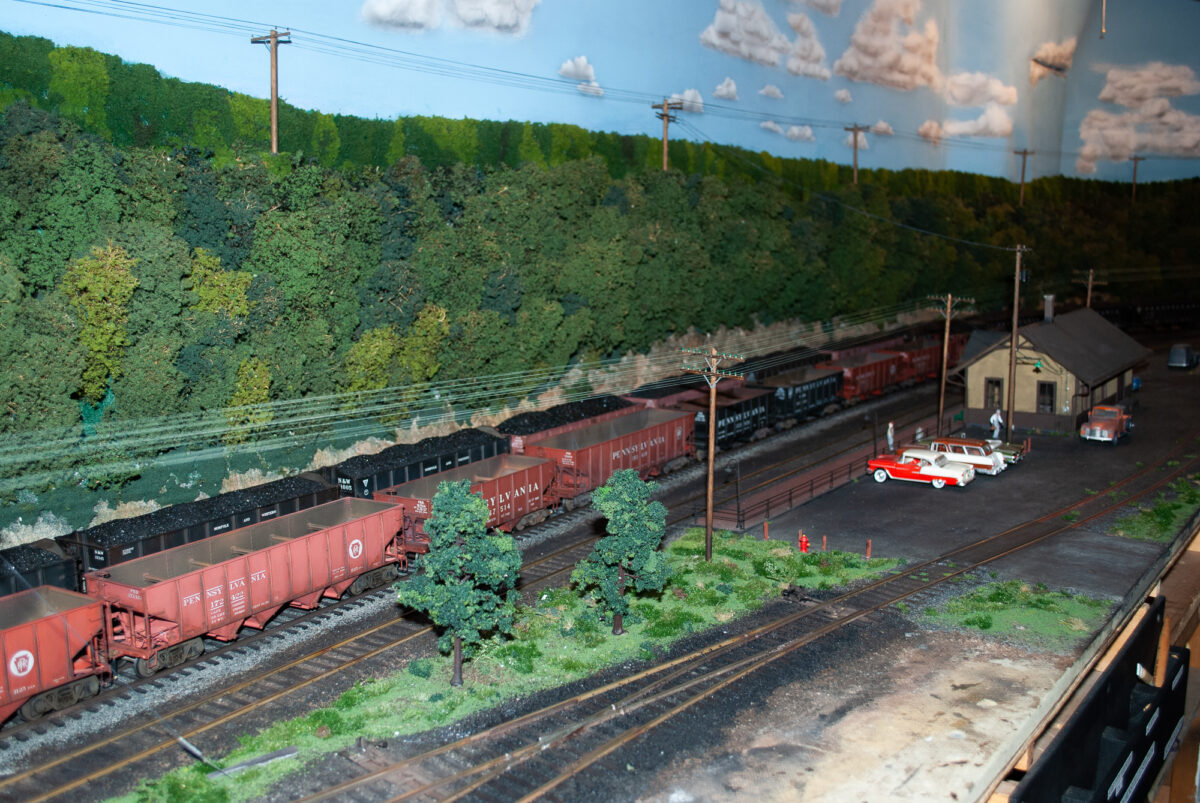
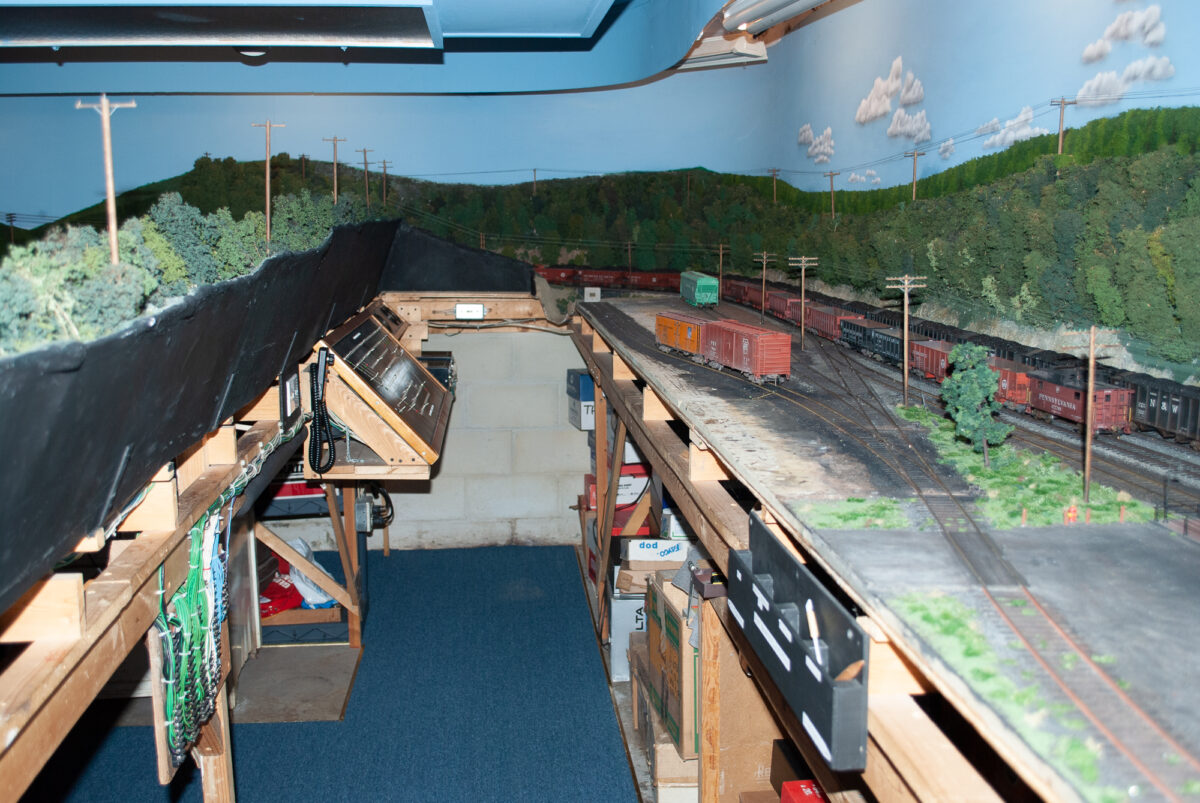
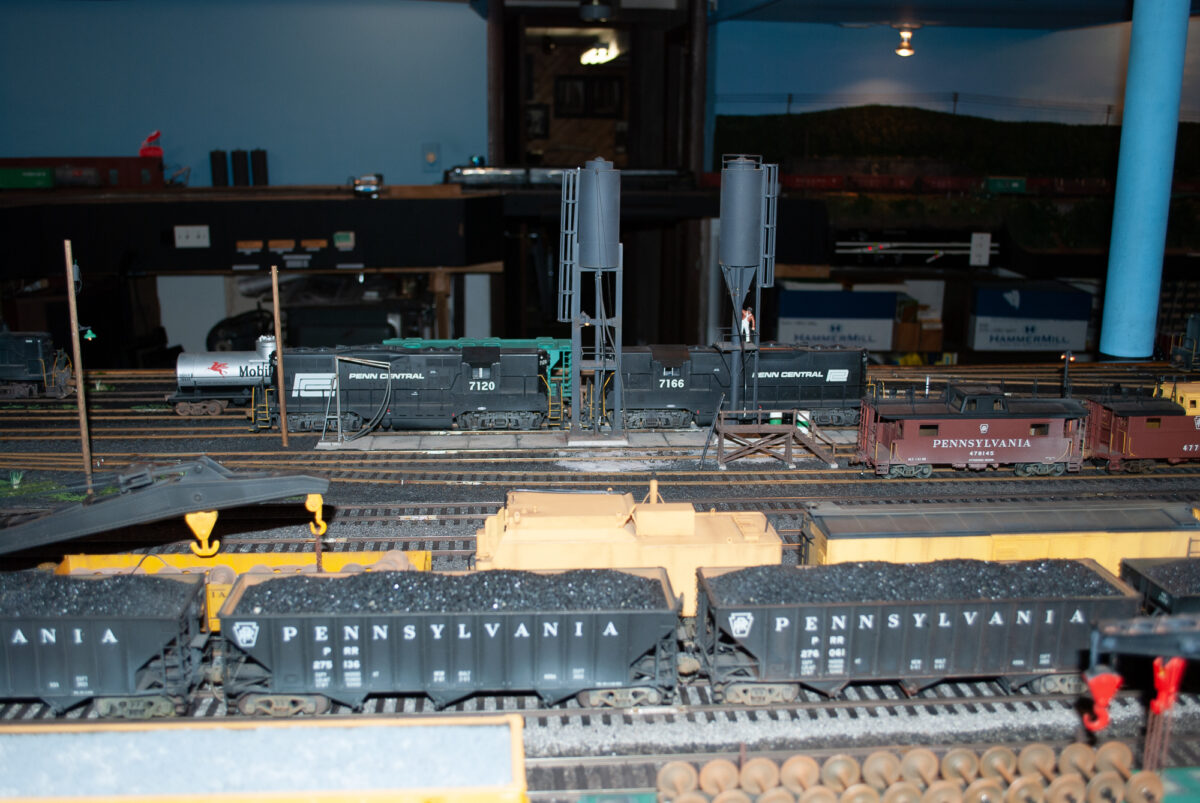
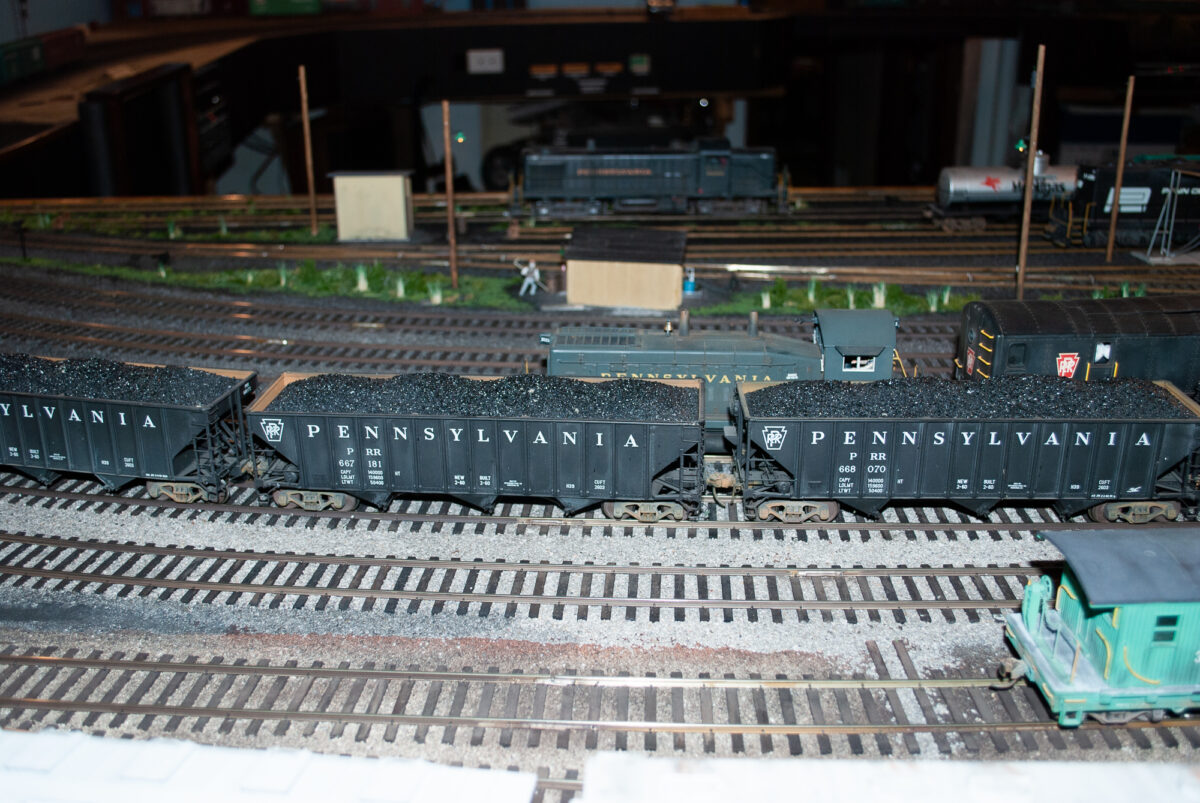
On the second night of the National, we went to visit Chris Smith’s layout. While only a small portion of the layout had scenery, you could see the passion Chris has for building scenery. The layout is based on a John Armstrong design. It winds and twists it way up through three levels of railroad, moving a lot of open hoppers up and down the railroad.
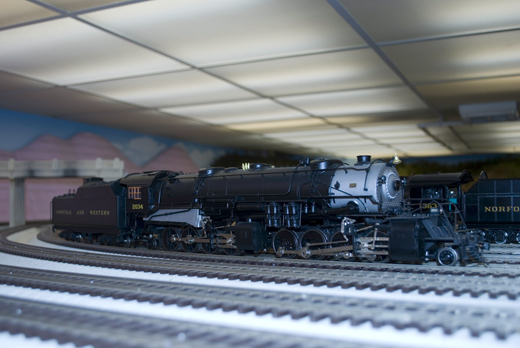
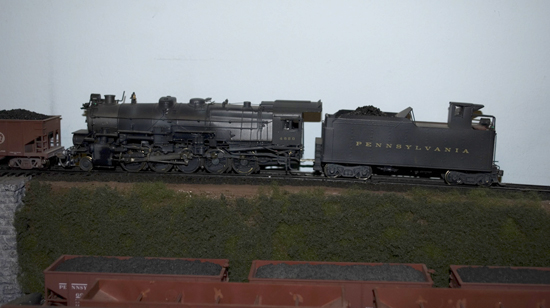
While we were there we saw a beautiful pair of Kohs Y6b’s pulling a nice open hopper train filled with a bunch of Rich Yoder’s hoppers. Turns out an MTH locomotive had to be put into service later that night when the Kohs engine had some trouble. The MTH locomotive was impressive in it performance. Overall the layout was nicely built and ran very well. Based on the scenery in place and how well the railroad operated, this is going to be a must see layout for the region.
Chris was a great host answering question well past the end time for the open house. This was one of the layouts I wanted to see and I was even more impressed than I thought I might be.
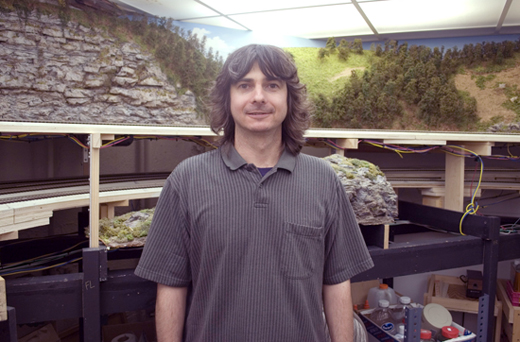
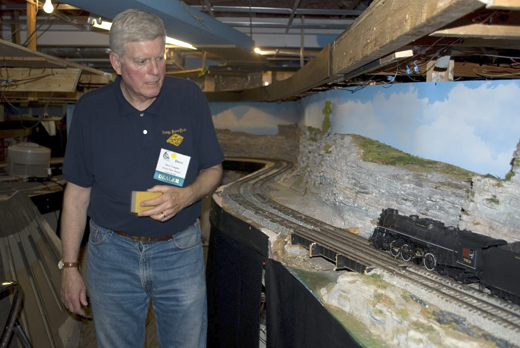
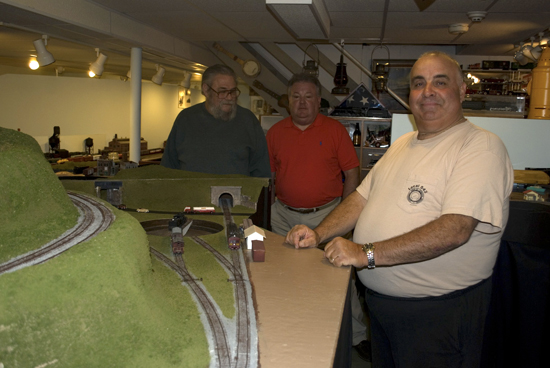
Chris Smith
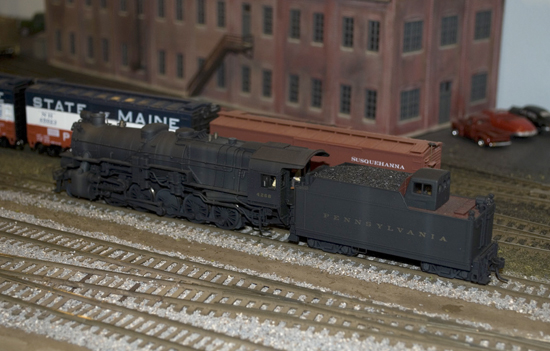
A Kohs Y6b waiting in front of the tunnel portal
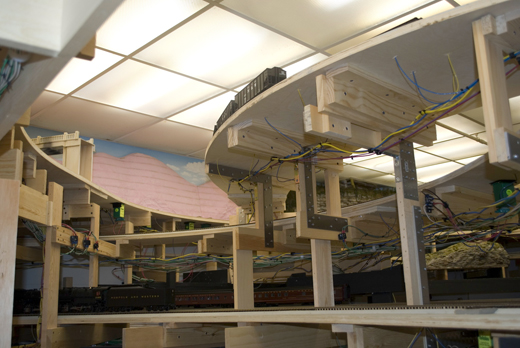
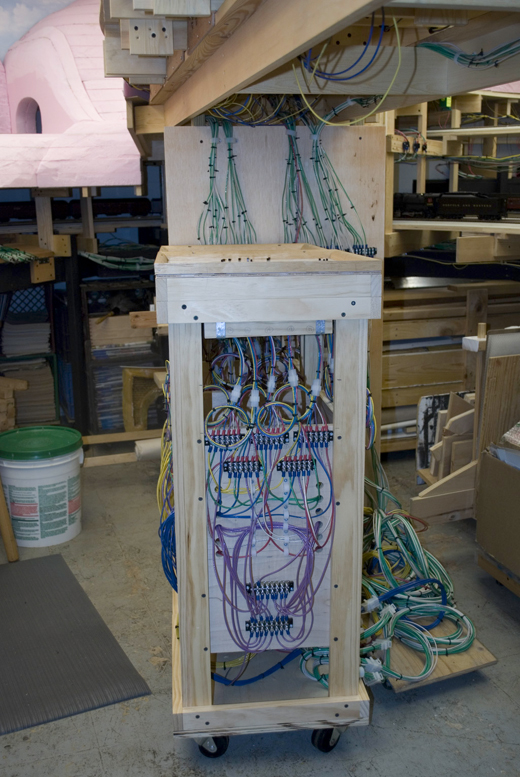
Chris’ rather nice brackets
Using one of two Atlas bridges for a duckunder
The upper yard with Chris in the background
Chris’ art
You can tell what he has a passion for
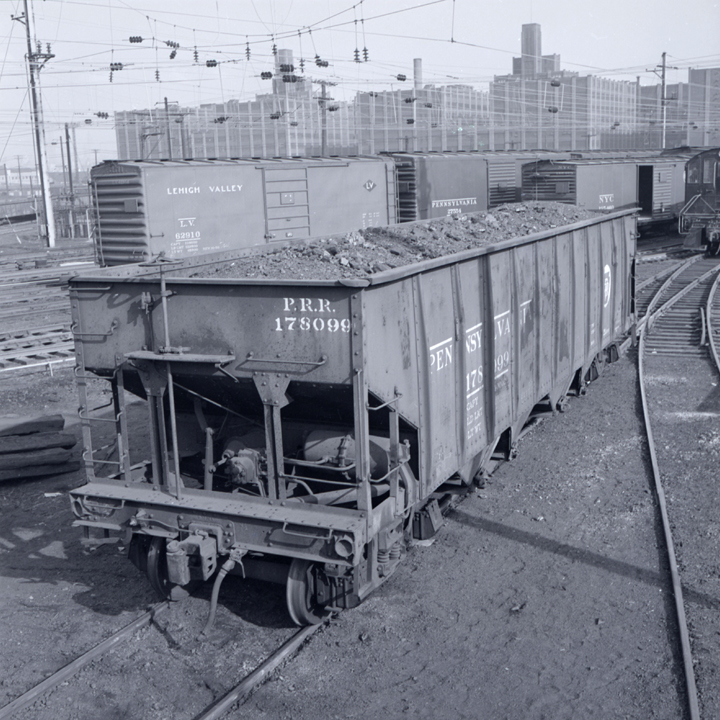
You have to like a nice string of open hoppers.
Another nice brass piece sitting in the upper yard.
another nice model
The before part of the corner
continuing down the outside wall
The entrance into the upper yard with sceanery started
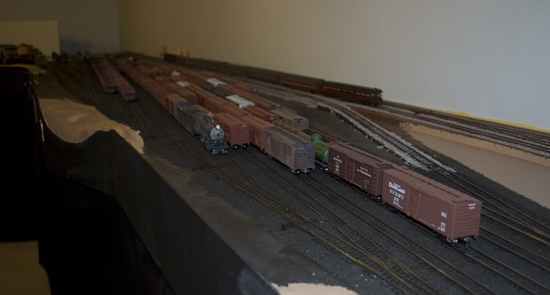
Looking across at the lower level yard with the two upper levels going over the top.
On the first night of the National, we had an invite to visit Dave Vaughn’s layout before it was open to the public and the crowds. I wish to thank Dave for the invite and the early look at the layout.
The layout is going through some changes. Dave has begun to incorporate parts of John Armstrong’s layout into his layout. And in John’s style, the layout winds and twists up through three levels of railroad. Some of the older portions of the railroad have not changed and reflect what was there in sceanery and structures.
Dave was a great host answering questions and telling stories about the influence of John Armstrong on himself and other local railroaders.
Dave Vaughn
Some very nice scenes in the older section of the layout
Dave had some very nice equipment parked on the sidings
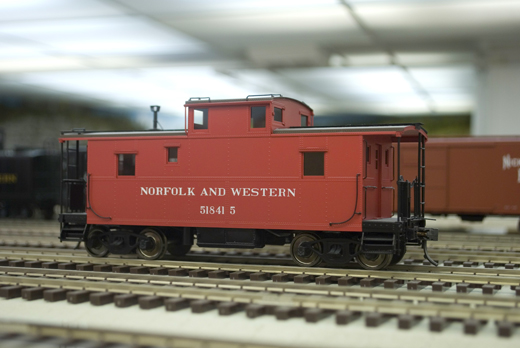
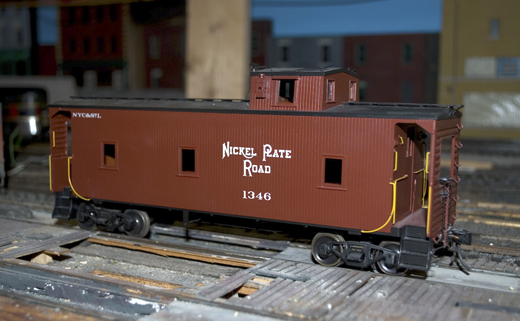
A wartime NKP caboose that Dave brught in as a brass model.
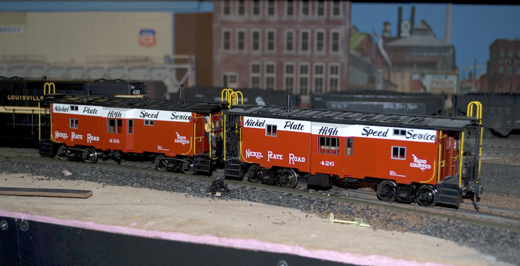
More nice cabooses in Dave’s NKP yard
A veiw looking back towars the NKP yard
A view looking back at the NKP yard which clearly shows the second level.
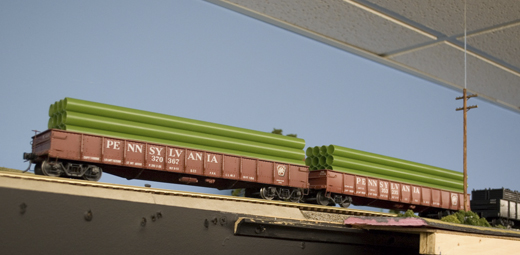
A couple of gondolas on the second level.
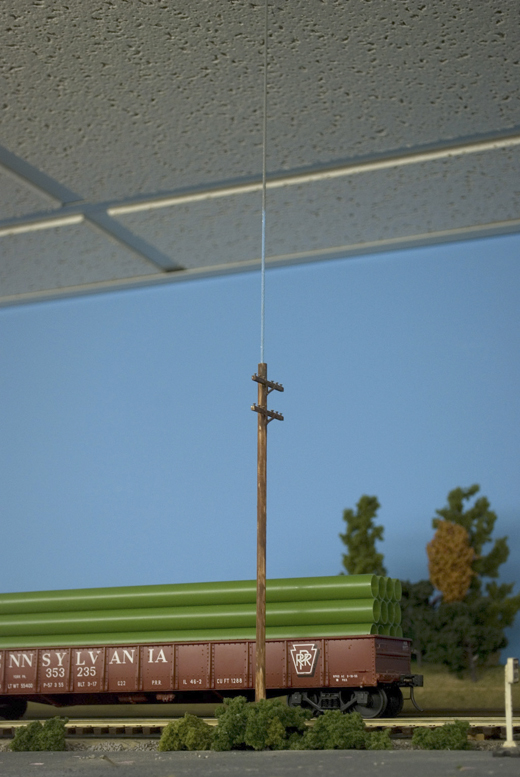
A view of the upper level support through the telephone pole.
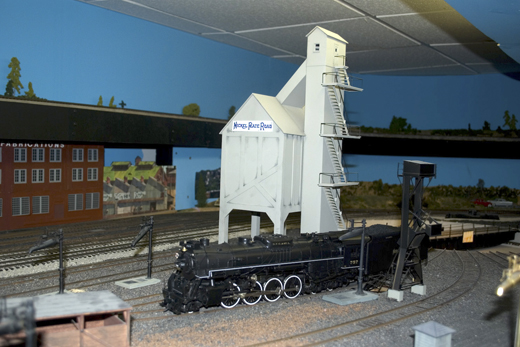
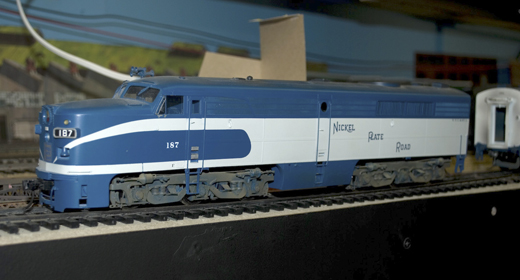
another nice NKP model
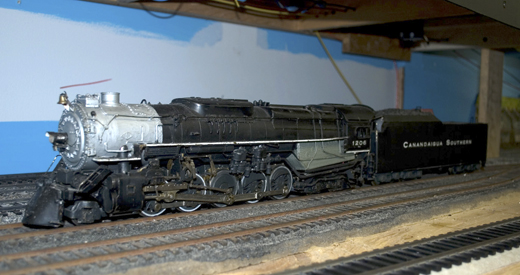
One of John Armstrong’s locomotives
A view of the “new” expansion
This is the entrance to the lower level reverse loops.
Dave is working parts of John Armstrong’s layout into his.
I just returned from the 2009 BOSS O Scale National. It was by far one of the best Nationals I had ever attended. The Baltimore group did a great job putting on the show.
The vending tables had a wide variety of stuff for all budgets. It was hard not to spend money everywhere. I’ll try to hit on what were a few of my highlights.
Weaver– They were showing a B&O Wagon top boxcar on their table. The examples on the table were older brass models meant to try to size up the interest in the crowd to see if they should produce the model. They mentioned that it would be built overseas and we should expect it to be close in quality and pricing to their B-60’s. I think it will be a winner.
Mullet River Model Works– They had some great new kits on the table and some fantastic details. Their NYC caboose would have gone home with me if I didn’t have a brass version of the same car sitting at home.
Rails Unlimited – Ted had many of his resin cast freight cars with him. Some were selling out and will not be re-run. I passed on the new B&O car, some modelers have complained about the casting quality of this new release, some that I know have returned their kits. I’ll wait for the Weaver version. I did come home with a PRR Gr gondola even though I had kit-bashed a similar car already.
RY Models – Rich had his Baldwin switchers on the table along with his tank cars. I also saw a lot of his trucks going home with people.
The layout tours were inspirational. Being at the starting blocks of my railroad, it made me re-think some of the decisions I made about what could be done. I’ll write about each of the layouts I visited in the coming weeks.
Last Thursday night, I had the pleasure of visiting Steve Staffieri’s HO scale Elmira Branch layout. John Dunn and Buzz Burnley had been invited to see the layout and they were kind enough to extend me an invitation.
It’s a nicely done railroad in a wonderful environment. The basement is nice and comfortable. The railroad has a finished feel to it even in areas that are still a work-in-progress.
The layout is based on the branch from Williamsport to Sodus Point, although it focuses on the run from Williamsport to Southport Yard in Elmira, NY.
My brother Bobb has an article and scale drawings of the PRR class H49 and H50 covered hoppers published in the June 2009 issue of Railroad Model Craftsman. Congrats to him.
I was just looking at the site and saw it listed in the table of contents. I hope the article looks good in print, I scanned the photos that went with the article.
This is the second set of drawings that he has published with RMC. He also had some LV passenger car drawings published to go with another author’s modeling article last winter.
Since the publication some SPF”s have writen some harsh comments about the drawings. I know exactly how that feels seeing that in print. That is one of the big reasons I stopped drawing for RMC back in the late 80’s. Too many experts sitting in their chairs doing nothing, but very quick to put down someone elses work.
This is very common for “PRR Modelers” Which also happens to be one of the best reasons to model the Reading Company!
Prototype History The H21 was originally designed as a 50 ton coke car. Construction of new H21 cars ran from 1909 through 1914. They were built by Altoona Car shops, Pressed Steel Car Co., Cambria Steel Co., American Car & Foundry, and Standard Steel Car Co.
A total of 21,738 car were built as the 50 ton H21 car class. It did not take long for the railroad to see that these cars had the capacity to hold 70 tons of coal. Lines West began converting the class into H21a’s in 1911. In 1912 the railroad began producing H22’s for coke service and converting the H21’s to handle coal. All H21’s would be converted to H21a by 1925. The conversion was basically placing 70 ton Crown trucks under the cars.
From 1915-1918 the railroad built an additional 14,270 H21a cars. The builders of the new cars were the same as for the H21’s with the addition of Ralston Steel Car Co. The railroad began to see that the frames were not able to hold up to the 70 ton coal loading. They began adding the reinforcement angle on the top sill from bolster to bolster starting in 1919. A corner to corner strengthened bulb angle would start appearing in the ’30’s but would not result in a class change. Nor would the conversion from original style “clamshell” hopper to “sawtooth” hoppers result in a class change.
The H21b class was created in 1930 when the railroad started a program to upgrade 100 cars with a 12 inch ARA center sill. This program was again done in 1943 to bring the total of H21b’s to 198. Externally there were no visible features to distingush the class besides the class stencil.
The H21d was a one-of-a-kind car conversition into a covered hopper car. While the H21d looks neat, I do not like to model one car classes. As I’ve pointed out before, most likely you would not have ever seen the car standing trackside in real life.
The class H21e first appeard in August of 1947 and reached a peak of 8,546 cars by January of 1953. The rebuild included adding a power hand brake and internal crossridge stakes. The power brakes had been applied to some H21a class cars without resulting in a class change. These H21a’s retained their internal cross ties at stakes 2, 4, 6, and 8. Some H21e car would have their side stakes welded on instead of the normal riveted side stakes.
In 1953 the PRR rostered 37173 class H21 hoppers. The OER did not fully split out the subclasses of “a”, “b” or “e.” Here are some fleet totals for the H21 class from 1952-1958 OER’s and the percentage that number represented to the total PRR open hopper fleet.
1952: 39702 cars 49.5% of the total PRR open hopper fleet
1953: 37173 cars 50.2% of the total PRR open hopper fleet
1956: 30737 cars 53.2% of the total PRR open hopper fleet
1958: 28020 cars 47.8% of the total PRR open hopper fleet
The PRR Steel Hopper book lists the following for class breakdowns for July of 1953: 35,256 total cars, 26576 H21a, 170 H21b, 1 H21d, 8509 h21e.
Cars of later subclasses are after my modeling time of 1952. I’ll let someone else talk about those classes.
References: Keystone Article PRR Steel Open Hopper Cars – John Teichmoeller January 1952 Official Railway Equipment Register September 1953 Official Railway Equipment Register April 1956 Official Railway Equipment Register
Modeling the H21’s in Proto48 In O scale we have been blessed with nice brass examples of the H21’s over the years. Some are clearly better, more accurate, or have finer details than others. And they have different price tags to go with them. The manufacturers of these cars are Precision Scale, Pacific Limited, Yoder Models and Keystone Model Works.
In recent years we have been blessed with a plastic version from Atlas O. While not a a finely detailed as some of the better brass car the cost about one sixth of the newest brass cars.
I hope to have additional posts about my modeling of these hopper cars.
On the trip back from the Cleveland Show in November, I had the chance to visit with Rob Enrico and see his Monogahela Division layout in person. I have to say that I seen his layout in print before but I wasn’t prepared for what it looks like in person. The photographs in print do not do it justice.
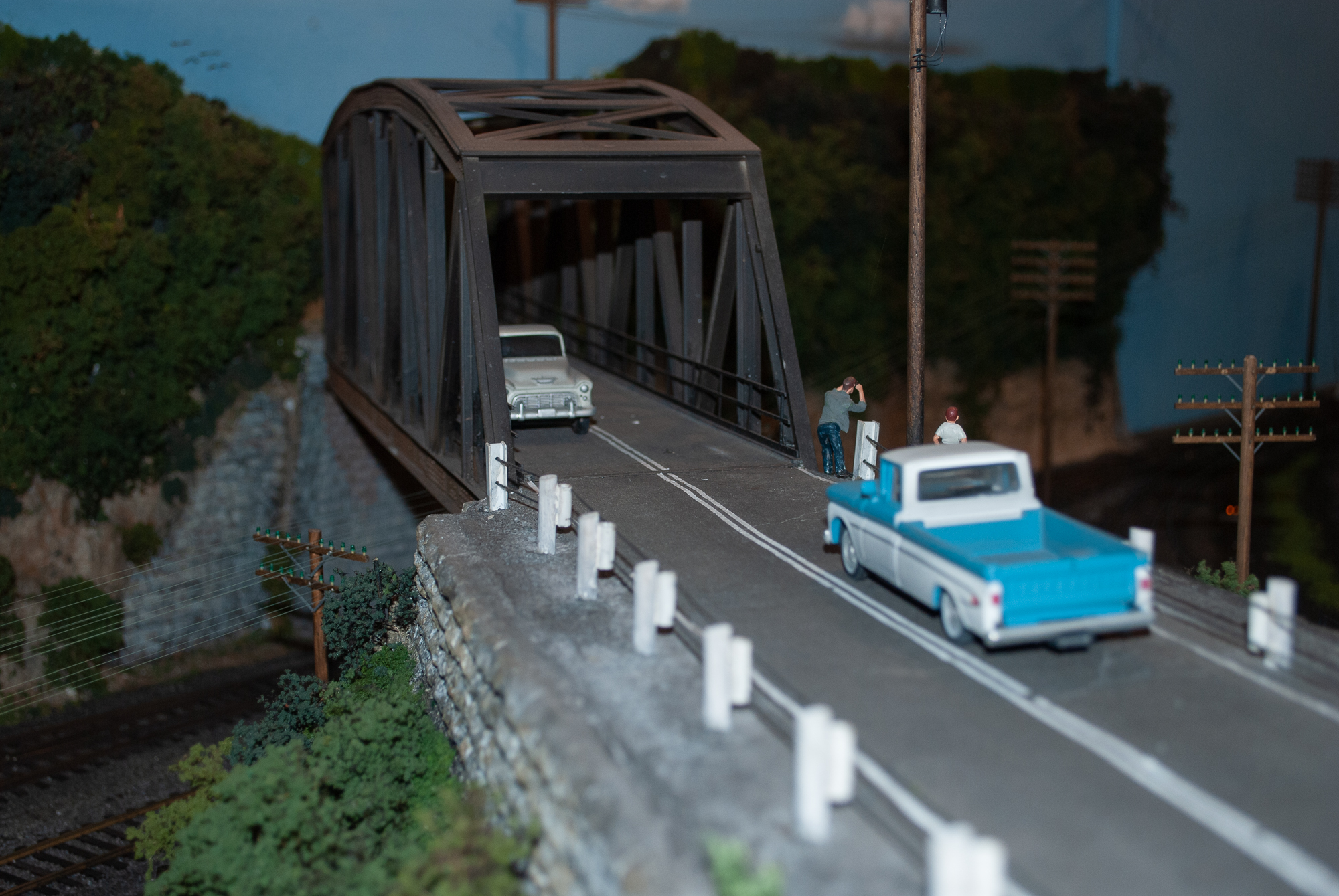
It’s actually a very simple layout if you look at the published plans. It’s basically a double track loop around his two car garage with a section across the middle for a yard area. What it may appear to lack because of the simplified track plan design, it makes up for in scenes that are recreated on the railroad. The rail fans on the overpass could have been my brother and me. Notice the fence posts.
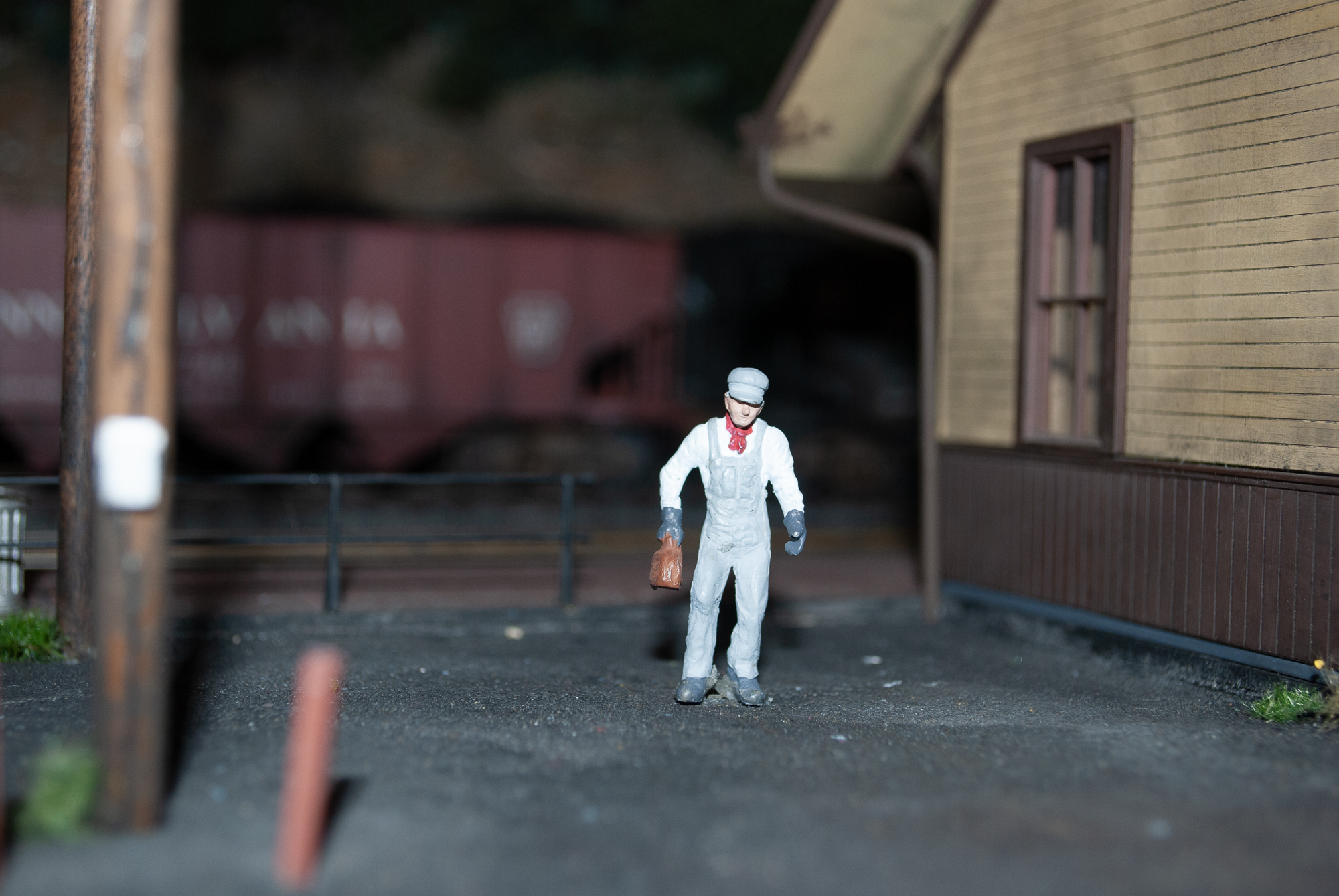
Or this simple scene of a crewman walking out to his car at the end of the workday. How many times have we seen that rail fanning? But how many times have you seen it on a layout?
Here is Rob talking with Rich Yoder about freight car truck.
The area that I have chosen to model is rich with open hopper cars. But it also has a few scheduled symbol freights moving through also.
So what does that mean really to my layout? It means I need a lot of open hopper cars. They will make up at least 60% of the traffic on the line.
Next question, how many cars are going to be home road cars? Looking at the photos and reading different accounts of the traffic on the line, you begin to understand that not all the cars are going to be Reading. What percentage are the off-road cars and what roads should be modeled is a topic in and of itself. But let hold that off until another time. Lets talk about what RDG open hoppers were on the roster in 1952.
Going back to the bible (January 1952 ORER) I was able to compile the following list of Reading open hoppers classes and their totals.
Class
No. of Cars
% of Total
Model Roster based on 50 cars
HTf
334
2%
1
HTh
4214
24%
12
HTj
1831
10%
5
HTl/HTn
3504
20%
10
HTo
995
6%
3
HTp
339
2%
1
HTr
996
6%
3
HTs
1654
10%
5
HTs (steel)
2
0%
0
HTt
1000
6%
3
HTu
749
4%
2
HTv
2000
11%
5
Totals
17618
100.0%
50
Look closely at the total number, 17618 open hoppers. Of the 17618 hoppers, only 2 HTs steel rebuilds have been built so far. What do you really think the chances of ever seeing one in a typical train? Not very high.
If you look at the percentage number that will give you an idea of how many cars of that class you might see on average for every 100 RDG hopper cars that run past you.
This is one of the best arguments I know of to NOT model one of a kind cars, unless you know they served s specific customer on your line. An example of modeling a one-of-a-kind car that ran on your line was the PRR X30 which ran out of Elmira, NY where it serviced the LaFrance Fire Engine Company. So when I was going to model the Elmira branch of the PRR I planned to build one.
References: January 1952 Official Railway Equipment Register October 1953 Official Railway Equipment Register April 1956 Official Railway Equipment Register
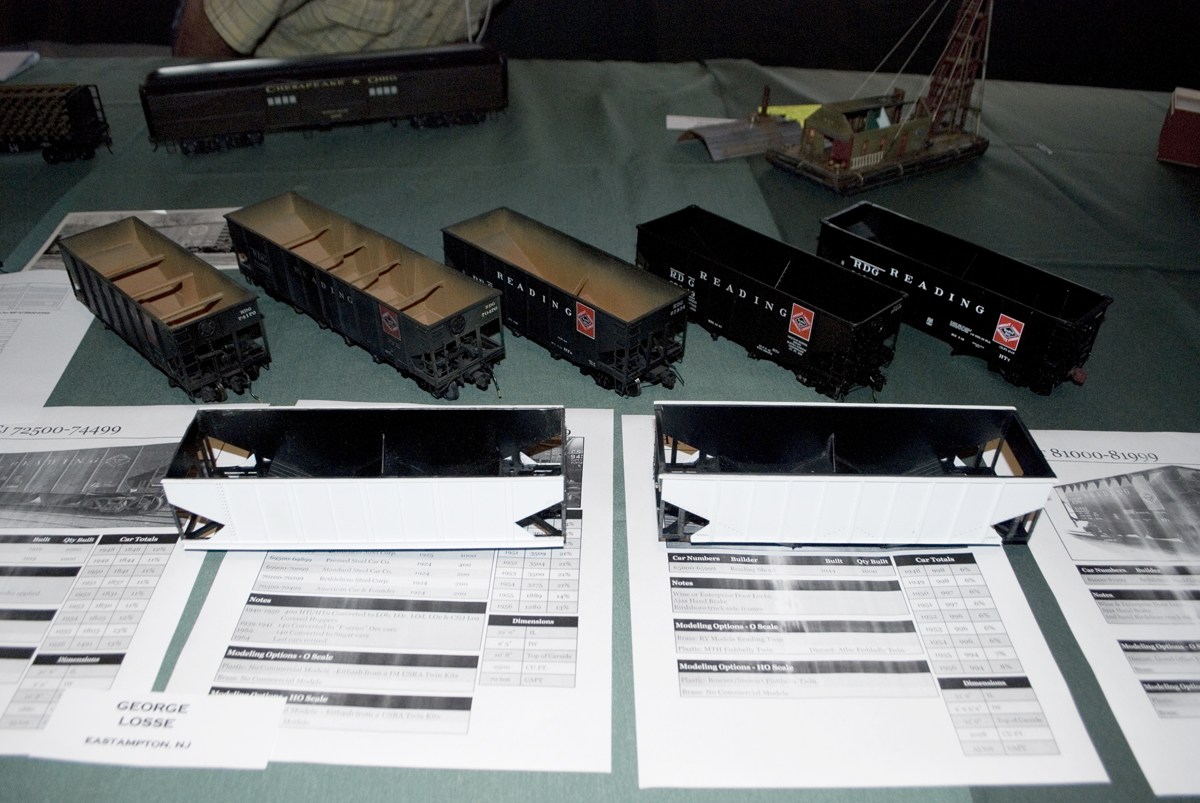
A few of my Reading open hoppers models on display at a local Prototype Modelers Meet. This was the year I presented a clinic at the RPM on Modeling the Reading Open Hopper Cars in the 1950’s
Why do I model?
I’m a Rail-fan I know that seems obvious but it’s also the driving force in a lot of the questions that follow. I enjoy seeing trains run in real-life and I enjoy recreating that in the models.
Details Are Important to Me I am not easily satisfied with good-enough modeling or research. I have drawn prototype locomotives and freight cars for Railroad Model Craftsman in the past. I have crawled all over a piece of equipment to take the notes needed for the drawings. I have also done the research at the museums and with private collections to find the answers needed for projects, that to me is a big part of the fun of this hobby.
What do I want to model?
Model Availability O scale does not have the same wide-selection of models that HO enjoys. That selection is made even smaller by not choosing to model either the PRR, SP, UP or NYC. Very few of the unique Reading Company prototypes have been produced over the years. I do not want to “have to” scratch build my whole locomotive fleet in order to realistically enjoy a modeled location. I’d like to build a layout and the models I want in this lifetime, not the next three lifetimes.
Small Town Switching I have a lot of early memories of watching a switcher working in the small town I grew up in. I would ride my bicycle into town to watch and photograph the local freight switch the town.
Open Hopper Cars My favorite type of freight car. I want to model an area that would have a lots of open hopper car traffic. Turns out that is a large part of the Reading, not just the mine runs themselves.
Sincere Track Design One where a train only goes through a scene or town once on its trip through the layout. This is a more modern approach to layout design instead of the “spaghetti bowl” layouts of the past that still dominate the O scale community.